
Josephson Concrete and Hardscapes · September 15, 2026 · Driveways
What a Concrete Driveway Costs in Wright County
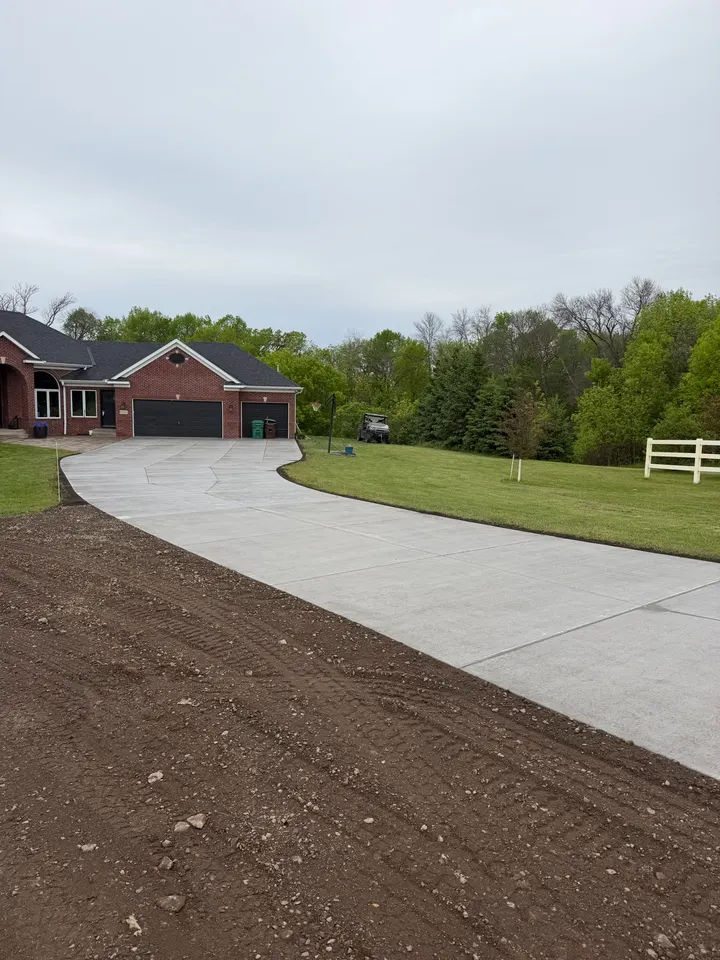
The short answer: the price of a concrete driveway comes down to square footage, thickness, what has to be torn out, the condition of the base underneath, how close the truck can get, the finish you choose, and details like aprons and saw cuts. A written quote should spell out each of those so you can compare bids on the same terms. In Wright County there are three more factors a national article will not mention: frost depth, road-approach permits, and a pour season that is shorter than most people think.
We do not print dollar figures on this site. Prices change with the cost of cement, fuel, and gravel, and a number that was right in April can be wrong by August. What does not change is the list of things that move the price. If you understand those, you can read any quote and know whether it is complete.
How much does a concrete driveway cost in Wright County?
The honest answer is that it depends on the lot, and a contractor who quotes over the phone without seeing it is guessing. Two driveways of the same length can land far apart once you account for what is under them. Below are the factors we price, roughly in order of how much they matter.
Square footage
Concrete is sold by the cubic yard and placed by the square foot, so the size of the driveway is the biggest single input. A two-car drive from the road to the garage on a typical lot in Buffalo is one thing. A long rural run out on a county road near Cokato is another, and a turnaround or a third stall adds to it again. When we measure, we include the apron at the street and any widening at the garage, because those are square footage too.
Thickness
Four inches is the standard for a residential driveway that carries cars and pickups. Five or six inches, usually with rebar or wire mesh, is what we recommend when the drive will see a camper, a boat trailer, a skid loader, or regular deliveries. Thicker concrete costs more per square foot, but the base prep, forming, and finishing labor are about the same either way, so going thicker is not as big a jump as most people expect.
Tearing out the old driveway
If there is an existing driveway, it has to come out. Asphalt breaks up and hauls fast. Old concrete takes longer, especially if it was reinforced, and it weighs more on the truck to the disposal site. Gravel driveways are the cheapest to prepare on the surface but often need the most work below it, because years of plowing push the gravel into the clay and leave a soft, uneven base.
Base condition in clay till
This is the factor that separates a driveway that lasts from one that heaves and cracks in three winters. Most of Wright County sits on glacial till, which is clay-heavy soil that holds water. Wet clay expands when it freezes and shrinks when it thaws, and a slab sitting directly on it moves with it.
The fix is a compacted gravel base between the clay and the concrete. How deep that base needs to be depends on what we find when we dig. A lot with firm, well-drained subgrade needs less. A low lot that stays wet in spring, or one where the old driveway was built on topsoil, needs more excavation and more gravel. We cannot know which you have until we open it up, so a good quote states the base depth it assumes and what happens if the subgrade is worse than expected.
Truck access
A ready-mix truck is heavy and needs a clear path. If it can back right up to the forms, the pour goes fast. If the driveway is behind a house, under low wires, or past a septic field the truck cannot cross, we either wheelbarrow the concrete, pump it, or bring it in with a smaller machine. All three add time and equipment. Access also affects the excavation and gravel delivery, not only the pour.
Finish
A broom finish is the standard for driveways and the least expensive. It gives traction in winter and holds up to salt and plow blades. An exposed aggregate finish costs more in labor and materials. Stamped or colored concrete costs more again, and on a driveway we usually steer people toward broom because it is the finish that survives Minnesota winters with the least maintenance. If you want a decorative look, a stamped border with a broom field is a middle path.
Aprons and saw cuts
The apron is the section where the driveway meets the road or the garage floor. It often has to match an existing curb line, a sidewalk, or the garage slab height, and that fitting takes extra forming. Saw-cut control joints are how we tell the concrete where to crack. On a curved or oddly shaped drive the joint layout takes more thought and more cuts. Both are small items on their own, but they are real work and belong on the quote.
What a written quote should list
When you get a quote, look for all of the following on paper:
- Square footage and thickness
- Base material and depth, and what is assumed about the subgrade
- Tear-out, hauling, and disposal of the old surface
- Reinforcement, if any
- Finish type
- Control joint layout and how joints will be cut
- Apron, curb, and sidewalk tie-ins
- Grading and topsoil along the edges
- Sealing, if included
- Who pulls the approach permit and what it covers
- Timing, including a realistic pour window
If a quote is a single number with no breakdown, you cannot tell what it includes, and you cannot compare it to another bid. Ask for the line items.
Three things a national article will not know
The cost guides that come up first in a search are written for the whole country. They miss three things that matter here.
Frost depth
Wright County builds footings to a 42-inch frost depth. A driveway is not a footing and does not go that deep, but that number tells you how far frost drives into the ground in a normal winter. That is why the base matters so much more here than it does in a state with a shallow frost line. It is also why a driveway that ties into a garage slab or a stoop needs an expansion joint, so the two can move separately through the winter.
Township and county approach permits
Where a new driveway connects to a public road, the road authority usually wants to sign off on the approach. On county roads that is the Wright County Highway Department, which issues access permits. On township roads it is the township. On a state highway like US-12 or Highway 55 it is MnDOT. The permit usually covers where the driveway can enter the road, the width, sight lines, and whether a culvert is required under the approach. A culvert, if one is needed, is a real cost item that has nothing to do with the concrete itself. We handle this as part of the job, but you should know it is there.
The short pour season
Concrete season in this part of Minnesota runs roughly from mid-April to October. That is the window in which the ground is thawed and the temperatures let concrete cure properly. Everyone who wants a driveway wants it in that same window, so spring bookings fill early and fall pours run into weather risk. Booking in late winter for a spring pour usually gets you a better spot on the schedule and more time to plan the base work.
Getting a number for your driveway
The only way to price a driveway honestly is to see the lot, measure it, and look at what is under the old surface. We pour concrete driveways across Wright County and along US-12, and we will come out, measure, and give you a written quote that lists every item above. If you are planning for next spring, now is a good time to get on the list.
Want us to look at your yard?
Free written estimate, measured in person, same-day callback.
Questions we get asked
Is a thicker concrete driveway worth paying for?
For most homes in Wright County a four-inch slab handles cars and light trucks. If you park a camper, a boat trailer, or a dump trailer on it, or a delivery truck backs in, five or six inches with reinforcement is money well spent. The extra concrete is a small share of the total because the base prep and labor are mostly the same.
Does tearing out an old asphalt driveway add much to the cost?
It adds a line item for breaking up the old surface, hauling it away, and paying the disposal fee. Asphalt is usually quicker to remove than old concrete. Where it changes the price more is underneath: an old driveway often hides a thin or wet base that has to be dug out and replaced before we can pour.
Why does my quote include an approach permit?
Where a driveway meets a public road, the road authority usually wants to approve the approach. That is the county highway department for county roads, the township for township roads, and MnDOT for state highways like US-12. The permit is normally a small fee and a form, but the driveway cannot legally connect to the road without it.
Can a driveway be poured in the fall or winter in Minnesota?
Late fall is possible with blankets and a careful mix, but once the ground freezes we stop. Concrete poured on frozen subgrade settles when the ground thaws, and fresh concrete that freezes before it gains strength is permanently weakened. Our driveway season runs roughly mid-April to October, which is why spring bookings fill early.
What should be listed on a written concrete driveway quote?
Square footage and thickness, the base material and depth, any tear-out and hauling, reinforcement, the finish, control joint layout, the apron and any curb or sidewalk tie-in, grading and topsoil along the edges, sealing if included, and who pulls the approach permit. If a quote is one number on a page, ask for the breakdown.