
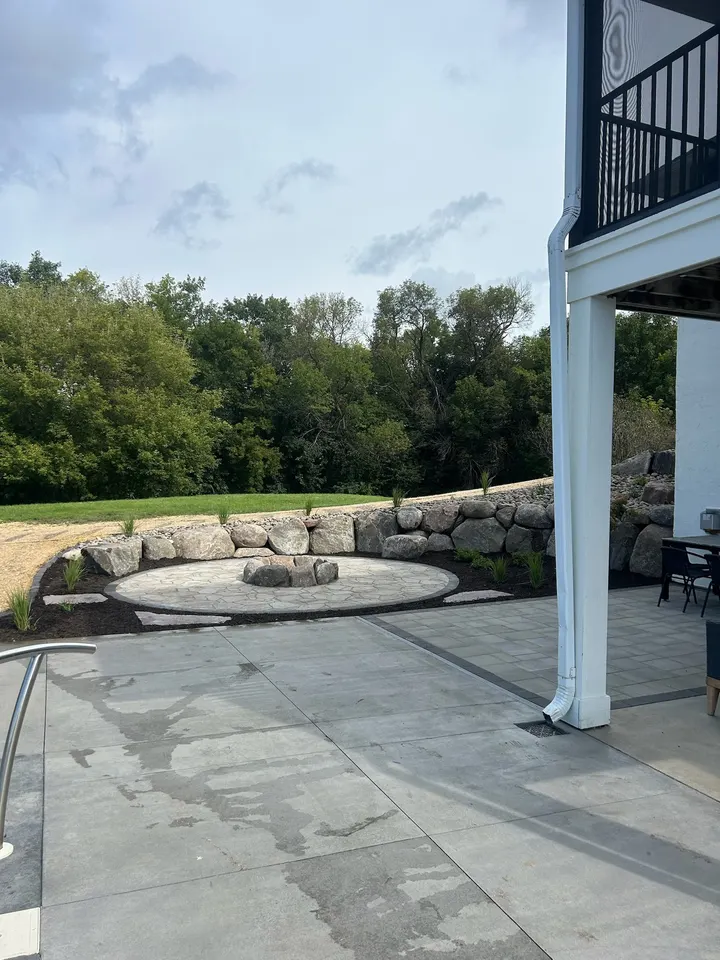
Stone or block, wood or gas
A stacked boulder fire ring is the most natural look and the simplest to build: fieldstone set in a circle, sometimes with a steel insert to protect the rock from direct flame. Cut natural stone matches a flagstone patio and dry-stacked walls, so the whole yard reads as one material. Wall block fire pits are the most precise, with a fire-rated ring or firebrick liner inside and a cap that gives you a flat edge to set a drink on. Wood-burning is the default. Gas gives you a flame on demand and no smoke, and it needs a gas line run by a licensed gas fitter and a burner kit sized to the pit. We build the pit and the pad, coordinate the trench, and the licensed trade makes the connection.
- Boulder ring: fieldstone, natural, quickest to set
- Cut stone: matches flagstone patios and stone walls
- Wall block: precise, capped, firebrick or steel liner
- Gas: burner and line by a licensed gas fitter, pit and pad by us
Setting a fire pit into the patio
A fire pit built during the patio job sits on the same compacted base as the patio, so it does not settle at a different rate and open a gap. We lay the circle out first, build the pit on a compacted aggregate pad, and run the pavers or flagstone up to it. The most common layout we build is a round paver pad with a soldier-course edge and the pit at the center, tied into a rectangular patio or set just off it on a lawn or gravel edge. Inside diameter usually lands between 36 and 44 inches, which is big enough for a real fire and small enough that people can still talk across it.
Clearances, wind, and seating walls
Where the pit goes is mostly a code question and a wind question. Cities set minimum distances from the house, deck, overhangs, fences, and property lines, and those distances differ from town to town, so check your local code and we will lay the pit out to meet it. Then we look at where the wind comes from, so the smoke goes toward the lawn and not the back door. A low seating wall around part of the pit, usually block or boulders, gives fixed seating and, on a sloped lot, does double duty holding the bank. A wall on the uphill side also blocks the wind that would otherwise blow the fire flat.
What drives the cost of a fire pit
A fire pit alone is a small job. What surrounds it is what moves the quote.
- Material: boulders, cut stone, or wall block
- Wood-burning versus gas, and the gas fitter's line run
- Size of the paver or flagstone pad around it
- A seating wall, and whether it also retains a slope
- Building it into a new patio versus cutting into an existing one
- Machine access for boulders
When we would talk you out of it
- A pit you want on a wood deck: it is a fire risk and most codes prohibit it, so we would set it on a patio or pad off the deck instead
- A lot where code clearances cannot be met from the house and the property line: a portable steel bowl on a paver pad is the honest answer
- A gas fire feature with no existing gas service at the house: the line and a propane tank setup are the licensed trade's job and may cost more than the pit
What you get
- Boulder, cut stone, or block to match the patio
- Steel ring or firebrick liner inside
- Built on the same base as the patio
- Laid out to local clearance rules
- Gas coordinated with a licensed fitter
- Seating walls that double as retaining walls
How it goes
- 1
Call or send the form
Tell us wood or gas, where you picture it, and whether it is going into a new patio or an existing yard.
- 2
Site visit
We check clearances, wind, the base under the spot, and where a gas trench would run if you want one.
- 3
Written quote
Pit, pad, seating wall, and gas coordination as separate lines so you can add or drop them.
- 4
Build and clean up
Pad, pit, pavers or stone, liner, and cap. First fire is yours.
Questions we get asked
How far does a fire pit need to be from the house?
It depends on your city. Codes set minimum distances from the house, deck, overhangs, fences, and lot lines, and Cokato, Buffalo, and Hutchinson do not all use the same numbers. Check with your city, and we lay the pit out to meet the rule before anything is set. Wind direction decides the rest.
Wood or gas: which should I pick?
Wood is cheaper to build, gives a real fire, and needs no trade beyond us. Gas lights instantly, makes no smoke or ash, and can be shut off when guests leave, but it needs a line run by a licensed gas fitter and a burner kit. Most of our customers on acreage pick wood; most in town pick gas.
Can you build a fire pit into my existing patio?
Yes. On a paver patio we lift the units in the circle, build the pit on a compacted pad, and reset the pavers around it. On a concrete patio we saw-cut a circle or build the pit on a paver pad set beside the slab. The pad is compacted so it does not settle away from the patio.
What keeps the stone from cracking in the heat?
A liner. Boulder and cut stone pits get a steel ring, and block pits get a steel ring or firebrick, so the flame does not hit the outer stone directly. Some fieldstone can spall or pop when it gets hot and wet, which is why we do not build a bare boulder ring without protecting it.
Related work
Where we do this work
Fire pits across western Wright County and the towns around Cokato: Maple Lake, Winsted, Cokato, Dassel, Howard Lake, Annandale, Buffalo, Delano, and the lake roads between them. See the full service area.