
Traction and pitch around the pool
A pool deck gets a broom finish, and we broom it a little heavier than a driveway because wet feet need grip. Stamped pool decks are possible, but the sealer that keeps stamped concrete looking good is slick when wet, so we add a grit additive to the sealer or steer people toward a broom field with a stamped or paver border. The deck pitches away from the pool wall at about an eighth to a quarter inch per foot so splash-out and rain run toward the yard or a deck drain, never back into the pool carrying dirt and sunscreen. Where the deck meets the house or a fence, we grade to a drain or a gravel strip so water has somewhere to go.
Coping, expansion joints, and the paver soldier course
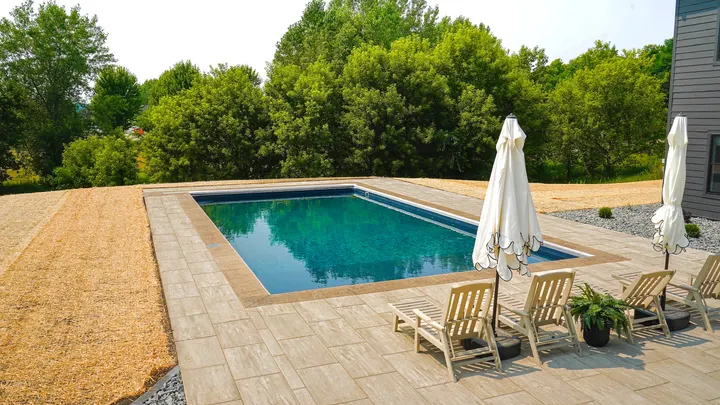
Coping is the cap on top of the pool wall. It can be poured as part of the deck (cantilevered coping formed over the pool's bond beam) or set as separate stone, precast, or paver units. Either way, an expansion joint runs between the coping and the deck, filled with foam and topped with a flexible pool-rated caulk, so the deck can heave or settle without pushing on the pool shell. That joint is the single most important line on the whole job. Around the outside, a soldier course of pavers set on edge gives the deck a clean border, hides the form line, and lets the deck's shape follow the yard without extra forming. The pool deck with a paver border in our photos is typical of what we build: a broom-finished field, a straight paver edge, and joints laid out to look planned.
A slab that stays wet all summer and freezes all winter
Freeze-thaw is what kills pool decks in Minnesota. The concrete soaks all summer, and the first hard freeze in November expands every drop of water in it. Three things keep the surface from scaling. The mix is air-entrained, so the water has room to freeze. The base is compacted class 5 gravel that drains, so the slab is not sitting in a saucer of wet clay. And we seal the deck after it cures, with a breathable penetrating sealer that slows water absorption without making the surface slick. Chlorine and, on saltwater pools, real salt are the other enemy, so the deck gets rinsed with fresh water before the cover goes on for winter. Skip the deicer on it entirely; nobody needs the pool deck plowed.
Working around the pool builder's schedule
A pool deck is the last big piece of a pool project, and it depends on trades ahead of it. The shell has to be in and the backfill around it settled and compacted, or the deck settles with it and cracks along the coping joint. The plumbing runs and the electrician's bonding grid around the shell go in and get inspected before the deck. We coordinate with your pool builder on that sequence, and we will tell you if the backfill is not ready. Autocovers, fence posts, and deck drains all need sleeves or blockouts in the pour, so we want those details before the forms go up, not after.
What drives the cost of a concrete pool deck
Pool decks are quoted from the pool builder's plan plus a site visit. What moves the number:
- Square footage of deck around the pool, and any extension for a seating area
- Coping type: cantilevered poured coping versus separate stone or paver coping
- Paver soldier course or other borders
- Finish, broom being the baseline and stamped or colored adding cost
- Backfill and base work if the pool builder's fill is not ready to take a slab
- Sleeves, blockouts, and drains for autocovers, fences, and downspouts
- Access for the truck, since pool yards are often fenced and a pump may be needed
When we would talk you out of it
- A pool whose backfill was placed last week. It has not settled. We would rather wait a few weeks and pour on firm ground than pour now and come back to cracks along the coping.
- Someone set on a smooth, glossy, sealed stamped finish around a pool used by kids. It is slick when wet. We will suggest a broom field with a decorative border instead.
- A deck that has to drain toward the house or a walkout. If the yard does not give us fall away from the pool and away from the house, the fix is grading or a drain line first, not concrete.
What you get
- Heavier broom finish for wet feet
- Pitched away from the pool wall and the house
- Foam-and-caulk expansion joint at the coping
- Paver soldier-course borders set to the deck's shape
- Air-entrained mix, drained base, breathable sealer for freeze-thaw
- Sequenced with your pool builder's plumbing, bonding, and backfill
How it goes
- 1
Send us the pool plan
The builder's drawing tells us the deck outline, coping type, and where the equipment and autocover sit. We start the quote from that.
- 2
Site visit
We check the backfill, the grade toward the yard and house, fence and gate access for the truck, and where deck drains would go.
- 3
Written quote
Deck area, coping, border, sealer, and any drainage work are broken out so you and the pool builder can see what is included.
- 4
Form, pour, seal
Once the shell, plumbing, and bonding are inspected and the fill is firm, we form, set sleeves, pour and broom, saw-cut, caulk the coping joint, set the border, and seal after cure.
Questions we get asked
What is the best finish for a concrete pool deck?
Broom finish. It gives bare wet feet grip, stays cooler than dark stamped surfaces, and is easy to clean and repair. If you want more than a gray slab, a paver soldier-course border or a stamped border around a broom field gives the look without a slick surface where people are running and jumping.
How far should a pool deck slope away from the pool?
About an eighth to a quarter inch per foot, away from the pool wall. On a ten-foot-wide deck that is one to two inches of fall, enough to keep rain and splash-out from running back into the pool. Where the deck meets the house we make sure water has a path away, using a drain or gravel strip.
When in the pool build does the concrete deck get poured?
After the shell is in, the plumbing and the electrician's bonding grid are inspected, and the backfill around the pool has settled and been compacted. Pouring before the fill is ready is the most common cause of a deck that cracks along the coping. We coordinate the date with your pool builder.
Will a concrete pool deck crack in a Minnesota winter?
Any slab can crack, but a pool deck that is air-entrained, poured on a drained gravel base, saw-cut on schedule, and separated from the pool wall by a proper expansion joint holds up. The ones that fail were poured on fresh backfill, skipped the coping joint, or got salted. Sealing after cure and rinsing chlorine off in fall help.
Can you add a paver border to a concrete pool deck?
Yes, and we do it often. A soldier course, a single row of pavers set on edge around the outside of the deck, gives a clean finished edge. We set it on a compacted base at slab height, tight to the concrete, and it can follow curves that would be expensive to form in concrete.
Related work
Where we do this work
Pool decks across western Wright County and the towns around Cokato: Buffalo, Cokato, Dassel, Howard Lake, Annandale, Maple Lake, Delano, Hutchinson, and the lake roads between them. See the full service area.