
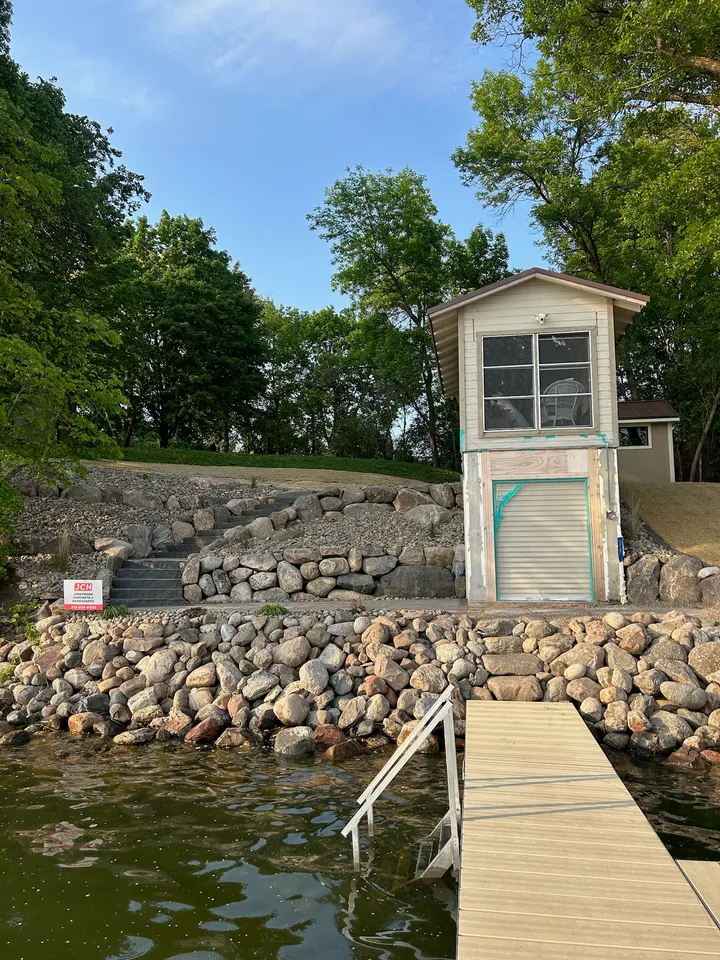
Lake steps and boulder stairs that hold on a clay bank
Steps down a lake bank fail for one reason: the soil under them moves. Glacial till gets soft when it is saturated, heaves when it freezes, and washes when runoff finds a path. Timber steps pinned into that soil tip within a few seasons. We set boulder steps instead, each stone bedded on compacted crushed rock, lapped onto the one below, and keyed into the bank on both sides so the hill holds the step rather than the other way around. Rise and run stay consistent so the stairs are safe in the dark with a cooler in one hand. On a long bank we break the run with a landing so there is a place to stop, and we run the stair with the slope rather than cutting a straight chute that becomes a drainage channel in the first storm.
Boathouse aprons, shed pads, and landings
A boathouse or lake shed on a bank needs a base that does not wash out from under it. We pour concrete aprons and pads on a compacted crushed-rock base with the surface pitched away from the building toward a spot that can take the water, so the slab sheds rain and the door threshold stays dry. Where a shed sits on the bank itself, we build the boulder wall first, backfill and compact behind it, then pour, so the pad rests on stable ground rather than on loose fill. Landings at the top and bottom of a stair are the same idea at a smaller scale: a packed crushed-rock or flagstone pad big enough to turn around on with a kayak under one arm.
Paths to the dock and seating on the bank
The path from the house to the dock takes more foot traffic than any patio, and it is always on a slope. We build it as a packed crushed-rock walkway, stepping stones set in compacted base, or a poured concrete walk, depending on the grade and how much the bank moves. Edges get boulders or a low wall so the path does not wash. For sitting, a flagstone or crushed-rock landing cut into the bank with a boulder edge gives you a fire pit or a pair of chairs at the water without building a deck. All of it is set to drain across the slope, never straight down it.
Pairing it with the shoreline work
Steps, landings, and aprons should go in with the riprap or boulder wall, not after. The equipment is already on the bank, the slope is already graded, and the same rules apply: work at or below the ordinary high water level usually involves the DNR, and grading in the shore impact zone usually needs a county land alteration permit, so one plan and one round of permits covers both. Steps that land on riprap need the rock keyed around them. A path that crosses a wall needs a break built into the wall. Doing it together means the whole bank is one system that drains, holds, and gets you to the water.
What drives the cost of waterfront hardscaping
Lake-lot work is priced from the bank up. The height, the access, and what has to be built under the feature matter more than the square footage.
- Height of the bank and how many steps and landings it takes to get down it safely.
- Boulder size, and whether the stair is boulders, flagstone treads, or poured concrete.
- Access for a compact machine versus hand-carrying stone down the slope.
- Whether a boathouse or shed apron needs a wall built and backfilled under it first.
- Drainage work so the path and steps do not become the runoff channel.
- Whether it is built with the shoreline work or as a separate trip with its own permit.
When we would talk you out of it
- A bank steep enough that the stair needs a structural handrail and code-framed stringers all the way up. That is a carpenter's deck stair on footings, and we will say so. We can build the landings and the shoreline under it.
- A lot where the goal is a deck or patio hanging over the water. Structures at or below the ordinary high water level get into DNR territory fast, and counties limit what goes in the shore impact zone. We will build the seating pad up the bank where it can be permitted.
- A lake lot that only needs the mud fixed. If the path is fine and the bottom step just floods, drainage and a small landing usually solve it. We will quote that instead of a full stairway.
What you get
- Boulder steps bedded on compacted crushed rock so they do not tip
- Landings where the slope breaks, big enough to set down a kayak
- Concrete boathouse and shed aprons pitched to shed water
- Paths that drain across the slope instead of down it
- Built with the riprap so one permit plan covers the bank
- Boulders set by machine and by hand to fit the bank you have
How it goes
- 1
Call with the lot in mind
Tell us the lake, how tall the bank is, what sits on it, and how you want to get to the water. Photos from the dock looking up the bank help.
- 2
Site visit on the bank
We walk the slope, find the natural line for the stairs, look at where water runs, and check where a machine can get in.
- 3
Written quote, with the shoreline if it needs it
You get one scope for steps, landings, aprons, and any riprap or wall, with the DNR and county permit steps for this parcel spelled out.
- 4
Build and clean up
We grade, set stone, pour any pads, seed the disturbed bank, and leave the yard clean.
Questions we get asked
Do lake steps need a permit?
Often yes, at the county level. Steps and paths in the shore impact zone count as land alteration under most shoreland ordinances, and grading more than a small amount of soil there usually needs a county permit. Anything at or below the ordinary high water level also involves the DNR. Check with your county planning and zoning office before you start. We sort this out with you as part of the quote.
Boulder steps or timber steps on a lake bank?
Boulder steps, in our experience. Timber steps pinned into clay heave and rot, and they usually need resetting within a few seasons. Boulder steps bedded on compacted crushed rock and keyed into the bank move with the ground and stay level. They cost more up front and less over the life of the lot. Timber makes sense only on a structural stair with footings, which is a carpenter's job.
Can you pour a concrete pad under my boathouse or lake shed?
Yes. We pour concrete aprons and pads on a compacted crushed-rock base, pitched to shed water away from the door and off the slab. If the shed sits on the bank we build and backfill the boulder wall first so the pad rests on stable ground. The same trip can include the steps down to it and the riprap in front of it.
How do you keep the path to the dock from washing out?
By making the water leave it sideways. We set the path to drain across the slope, edge it with boulders or a low wall, and build it on compacted base, whether it is crushed rock, stepping stones, or poured concrete. Downspouts and lawn runoff get routed away from it before they reach the bank, which is usually where the washing starts.
Can this be done without tearing up my yard?
Mostly. We use compact equipment that fits a lake lot, run it over mats where the lawn is soft, and carry stone by hand on the tightest banks. There will be some disturbance on the slope itself, which is unavoidable, and we seed or blanket that when we are done so it grasses in over the season.
Related work
Where we do this work
Waterfront hardscape across western Wright County and the towns around Cokato: Dassel, Annandale, Litchfield, Winsted, Cokato, Howard Lake, Maple Lake, Buffalo, and the lake roads between them. See the full service area.