
Thickness: cars versus trucks and trailers
A driveway that only sees cars and light SUVs gets four inches of air-entrained concrete over a compacted class 5 base, with fiber in the mix or a mat of rebar. If you park a three-quarter-ton pickup, a camper, or a boat trailer, or you have a propane or delivery truck that backs up to the garage, we go to five or six inches with rebar on chairs. The extra inch or two costs less than it sounds because the forming, base, and finishing are the same job. Thickness at the apron and in front of the garage door is where it matters most, because that is where tires turn and loads sit still.
Curves, aprons, and the approach at the road
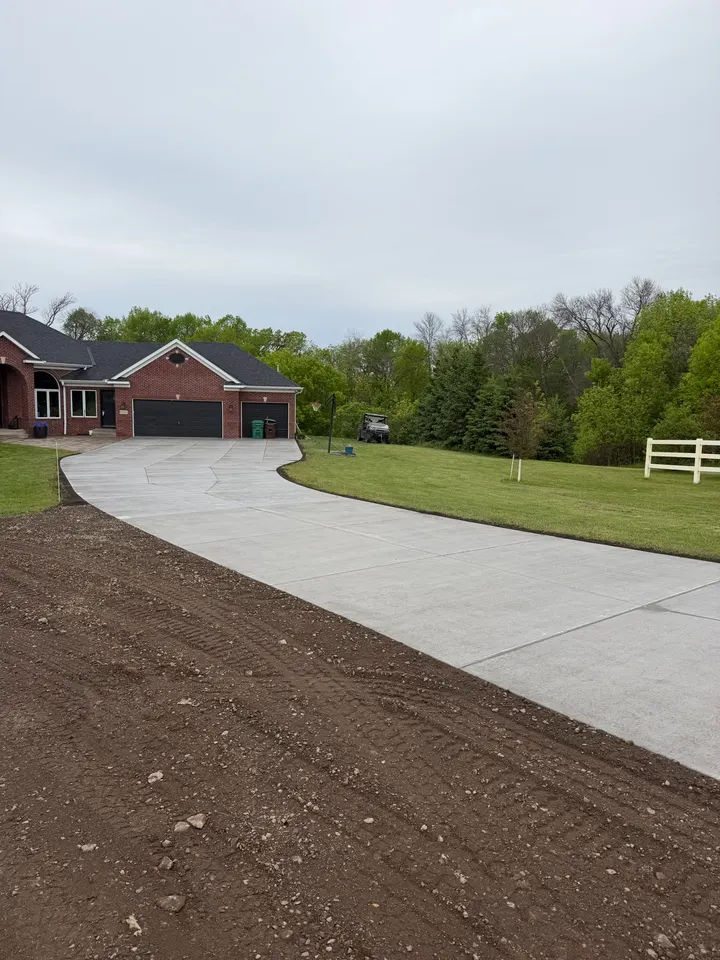
A curved driveway is formed with flexible forms or bent plywood and is poured the same way as a straight one, but the layout takes longer and the saw-cut joints have to be planned so they still look intentional. The driveway we poured in Hanover is a good example: a long broom-finished drive that curves to a brick house, jointed so the lines follow the curve. At the road, the apron is the strip between your driveway and the pavement. On a township road that is usually a gravel shoulder, and the apron takes plow damage every winter, so we thicken it and keep the joints tight. On rural lots there is often a culvert under the approach that has to stay clear. Approach work usually needs a permit from the city or township, and rules on width and culvert size vary, so check with the city or township before we dig. We can tell you who to call for your address.
Replacing an old driveway
Most of the driveways we pour replace one that is already there: heaved asphalt, a cracked and scaled concrete slab, or gravel that has turned to ruts and mud. We break out and haul away the old surface, then look at what is under it. Old driveways often sit on an inch or two of gravel over clay, and that base is why they failed. We excavate to a firm layer, bring in new class 5, and compact it in lifts. If the old driveway drained toward the garage, this is the chance to fix the grade so the new one does not. Downspouts that used to dump onto the slab get extended past it.
Broom finish and where the joints go
We broom-finish driveways because it gives traction when wet or frosted and is the easiest surface to plow and shovel. The broom lines run across the direction of travel. Joints are saw-cut the day after the pour, usually every ten to twelve feet on a four-inch slab and laid out in squares or near-squares, with a joint at the garage slab and a joint along the apron. An expansion joint separates the driveway from the garage floor and from any sidewalk so the slabs can move independently.
What drives the cost of a concrete driveway
Every driveway is quoted from a site visit. The variables that move the number:
- Length, width, and any turnaround or parking pad
- Thickness and reinforcing, four inches with fiber up to six inches with rebar
- Removing and hauling the old asphalt, concrete, or gravel
- Base condition and how much excavation and new gravel the clay needs
- Curves and complex layouts, which take more forming and joint planning
- Distance from where the ready-mix truck can park to the forms
- Apron and culvert work at the road, and any grading to fix drainage
When we would talk you out of it
- A lot with a septic drain field or tank under the proposed route. We will not pour over either one, and neither should anyone else. Reroute the driveway or stay with gravel over that stretch.
- Freshly backfilled utility trenches or a new house lot that has not settled. Give the fill a season to settle, or we compact and build it up properly, which adds cost you should know about up front.
- A budget that fits asphalt better. If the driveway is very long and plain, asphalt may be the honest recommendation. We will say so at the site visit.
What you get
- Four to six inches of air-entrained concrete on compacted class 5
- Thickened aprons and garage approaches where loads sit
- Joints saw-cut the next day, laid out to fit curves
- Old asphalt or concrete broken out and hauled away
- Grade corrected so water runs to the road, not the garage
- Broom finish that plows and shovels clean
How it goes
- 1
Call with the rough size
Tell us the length, what is there now, and what parks on it. That tells us thickness and whether removal is involved.
- 2
Site visit and layout
We walk the route, check the grade, look for the culvert and the drain field, and paint the outline so you can see the width and any curve before it is set in concrete.
- 3
Written quote and permit check
The quote lists thickness, reinforcing, base, and removal. We flag whether the approach at the road usually needs a township or city permit for your address.
- 4
Tear out, base, pour, cut
Remove the old surface, excavate and compact new base, set forms and rebar, pour and broom, saw-cut joints the next day, and clean up. Cars stay off for about a week.
Questions we get asked
How thick does a concrete driveway need to be for a truck?
Four inches handles cars and SUVs. For a heavy pickup, a camper, a boat trailer, or a delivery truck that backs up to the garage, we pour five or six inches with rebar on chairs. The base under it matters as much as the thickness; a compacted gravel base carries the load and a soft clay base does not.
Do I need a permit for a driveway in Wright County?
The driveway on your own lot usually does not, but the approach where it meets the road usually does, from the city or the township that owns that road. Rules on width, culvert size, and setback vary by township. Check with the city or township office before we dig, and we can point you to the right one.
Is concrete or asphalt better for a driveway in Minnesota?
Concrete costs more up front, lasts longer, and does not soften in July or need sealcoating. Asphalt is cheaper for very long rural drives and is easier to patch. For a driveway near the house that you want to look good for decades, we recommend concrete. For a quarter mile of plain drive, asphalt may win.
How long does it take to replace a driveway?
Most driveway replacements take three to five working days: a day to break out and haul the old surface, a day for excavation and base, a day to form and pour, and a return trip to saw-cut joints and strip forms. Weather can stretch it. You will be parking on the street for about a week after the pour.
Why did my old driveway heave and crack?
Almost always the base. Older driveways around Cokato were often poured on a thin layer of gravel over clay, and clay holds water and swells when it freezes. Missing or shallow control joints and a mix without air entrainment make it worse. A new driveway fixes it with a deeper compacted base and joints cut on schedule.
Related work
Where we do this work
Driveways across western Wright County and the towns around Cokato: Cokato, Dassel, Howard Lake, Maple Lake, Buffalo, Delano, Hutchinson, Litchfield, and the lake roads between them. See the full service area.